An urgent call to establish a National Just Transition Fund
Prepared with SEFiA’s advisory leadership under WWF Türkiye’s “Strengthening the Financing of Just Transition” project and supported by the ILO, the report “Proposal for a Just Transition Finance Mechanism for Türkiye” calls for the establishment of a National Just Transition Fund that consolidates central budget resources, carbon pricing revenues, and international climate finance into a coherent national financing framework.
Energy, industry, and transport account for more than 70% of Türkiye’s total emissions. Continued dependence on fossil fuels in power generation and high carbon intensity in industry make the transition both urgent and structurally complex. As the shift toward low-carbon production is closely linked with energy security, employment restructuring, and regional development policies, it is critical that the transformation encompasses both the electricity sector and carbon-intensive industries. Drawing on international experience, the study demonstrates that establishing a nationally owned, multi-stakeholder, transparent, and performance-oriented Just Transition Finance architecture that simultaneously finances social, economic, and environmental transformation is no longer a policy option that can be postponed.
Structural Implications for Türkiye and the National Just Transition Fund (NJTF) Proposal
The report aims to present a holistic framework that treats just transition not merely as a climate policy instrument but as a strategic field that jointly restructures regional development and the transformation of carbon-intensive sectors. It identifies three key structural conclusions for Türkiye:
- Just transition is not only an energy policy issue but a comprehensive transformation agenda encompassing employment, industrial restructuring, regional development, and social policy.
- While international funds are important, the social sustainability of just transition in Türkiye requires core financing to be anchored in national budgetary resources and stable domestic revenue streams.
- Financial resources must be directed not only to technical carbon-reduction projects but also systematically toward workforce transition, training, income compensation, and local development.
Governance and Institutional Design
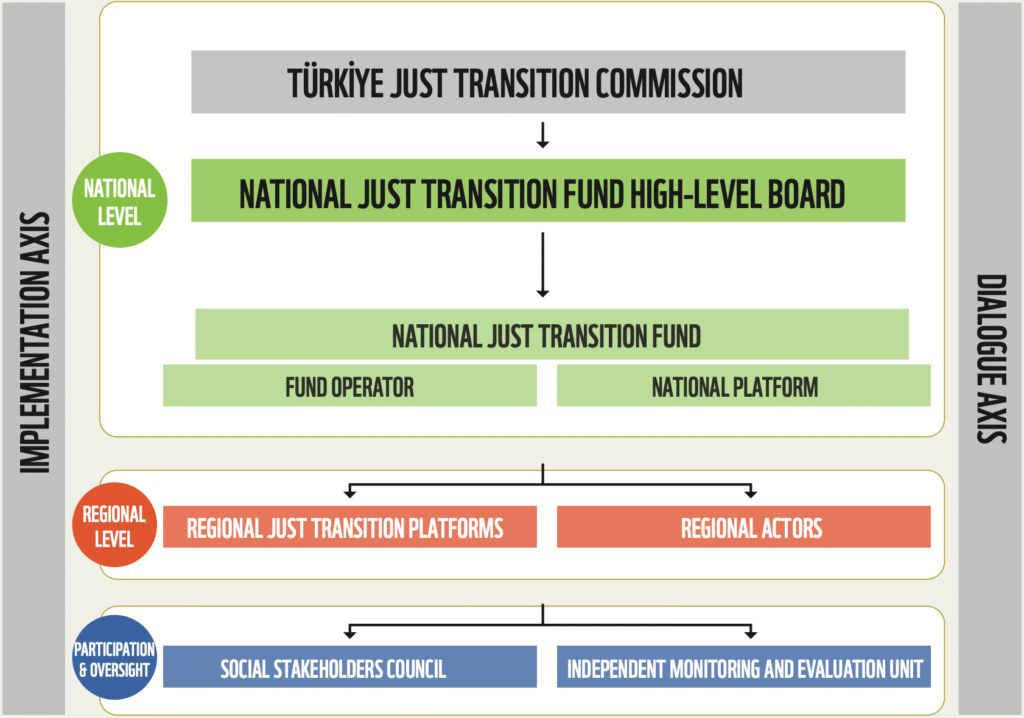
To ensure effective implementation, the report proposes a multi-layered governance structure that combines national strategic coordination with regional participation and delivery mechanisms.
At the national level, policy direction defined by a Türkiye Just Transition Commission would be operationalised through the NJTF Governing Board and Platform, translating strategy into concrete financing and implementation decisions.
At the regional level, Just Transition Platforms and Regional Actors would lead planning and execution.
A Social Stakeholders Council and an Independent Monitoring & Evaluation Unit would ensure democratic participation, transparency, and accountability across the entire system.